Third-Party Integrations
Please let us know if you would like to see additional functionality.
Use the APIs described in this section to integrate third-party systems (e.g., third-party ad servers).
Please refer to the Client APIs to integrate a media player with our service.
Basic Information
Use the following information to become acquainted with our Third-Party Integration APIs:
-
RESTful APIs
These APIs follow a simplified version of RESTful conventions. Specifically:
- Only GET and POST HTTP methods are used.
- Parameters are not defined in the request URL.
-
Programming Language
These APIs are language-agnostic and therefore may be called using any modern programming language.
-
Authentication
Each request must be signed via your API key.
-
Request
- Scheme: All requests must use the HTTPs scheme (i.e., https://).
- Domain: All requests must be directed to services.uplynk.com.
- Request Parameters: Each endpoint requires a message, which is an encoded JSON object, and a digital signature to be passed as URL-encoded parameters.
-
Response
The response is a JSON object. This object always contains an error member that reports an integer. A value of 0 indicates that an error did not occur. If an error occurred, then this JSON object will typically include a msg member that describes the error.
Messages and Signatures
Each endpoint requires the following URL-encoded parameters:
-
msg: This encoded JSON object identifies your account by user ID (i.e., _owner) and indicates the timestamp (i.e., _timestamp), in seconds (UTC), at which this message was generated. It may also contain any additional parameters specific to the endpoint being requested.
The msg parameter must include _owner and _timestamp.
 Where can I find my user ID?
- Load the User Settings page. How?
- Your user ID is listed under the User ID label.
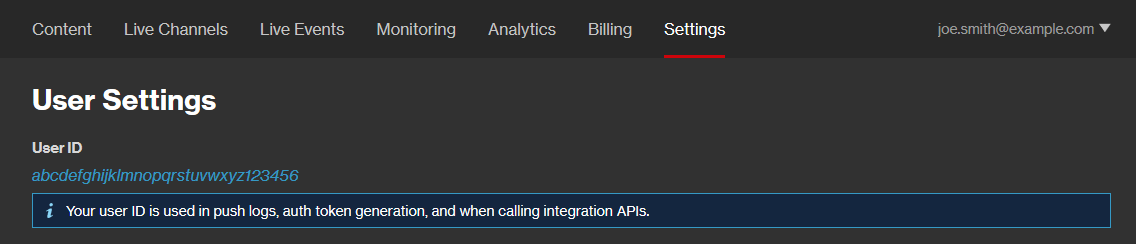
- Load the User Settings page.
-
sig: This parameter is a digital signature for the msg parameter.
Encoding a Message
Encode the msg parameter by:
- Constructing a JSON string representation of the request parameters for the endpoint being called.
- Compressing the above JSON string using zlib.
- Base-64 encoding the above JSON string. This will remove whitespace characters.
Signing a Message
Sign a message by computing the HMAC-SHA256 digest of your secret API key and the msg parameter.
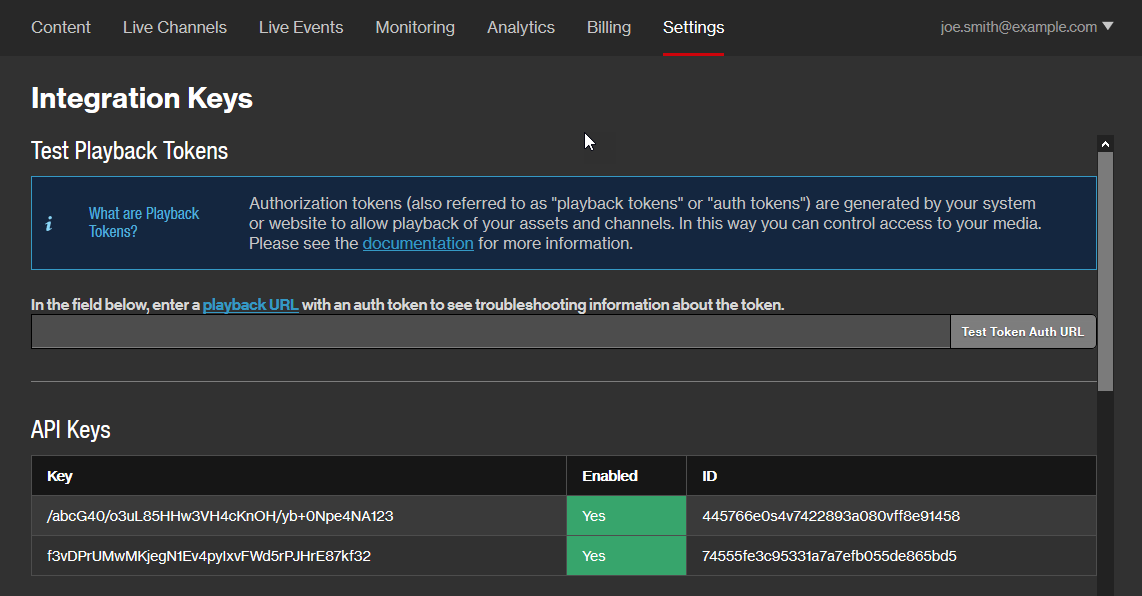
Where can I find my API key(s)?
- Navigate to the Integration Keys page by clicking the Settings tab and then clicking Integration Keys from the side navigation tab.
- Your API key(s) are listed under the API Keys section.
Code Samples
Sample code provided for each endpoint imports the Call() function from the uplynk_api2_auth module. Substitute the values for USER_ID and API_KEY with your own user ID and API key, respectively.
Common API code (Python 3):
import base64, hashlib, hmac, json, time, urllib.parse, zlib
from urllib.request import urlopen

ROOT_URL = 'https://services.uplynk.com'
USER_ID = '1234567890abcdefghijklmnopqrstu' # Replace with your user ID.
API_KEY = '1234567890abcdefghijklmnopqrstuvwxyz1234' # Replace with your API key.

def Call(uri, **msg):
    """Base method for Uplynk API (api2) calls"""
    msg['_owner'] = USER_ID
    msg['_timestamp'] = int(time.time())
    msg = json.dumps(msg)
    msg = zlib.compress(msg.encode(), level=9)
    msg = base64.b64encode(msg).strip()
    sig = hmac.new(API_KEY.encode(), msg, hashlib.sha256).hexdigest()
    body = urllib.parse.urlencode(dict(msg=msg, sig=sig)).encode('utf-8')
    return json.loads(urlopen(ROOT_URL + uri, body).read())

print(Call('/api2/fake', foo='some value', bar=15))
Common API code (Node.js):
const crypto = require("crypto");
const https = require("https");
const querystring = require("querystring");
const zlib = require("zlib");

const ROOT_URL = "services.uplynk.com";
const USER_ID = "1234567890abcdefghijklmnopqrstu"; // Replace with your user ID.
const API_KEY = "1234567890abcdefghijklmnopqrstuvwxyz1234"; // Replace with your API key.

function call(uri, options) {
	let msg = {
		_owner: USER_ID,
		_timestamp: parseInt(Date.now() / 1000),
		...options,
	};
	msg = JSON.stringify(msg);
	msg = zlib.deflateSync(msg, { level: 9 }).toString("base64");
	const sig = crypto.createHmac("sha256", API_KEY).update(msg).digest("hex");
	const body = querystring.stringify({ msg, sig });
	const url = `${ROOT_URL}${uri}?${body}`;
	return post(ROOT_URL, uri, body);
}

function post(host, path, data) {
	return new Promise((resolve, reject) => {
		let respData = "";
		const req = https.request({ host, path, method: "POST" }, (res) => {
			res.on("data", (chunk) => (respData += chunk));
			res.on("end", () => resolve(JSON.parse(respData)));
		});
		req.on("error", (err) => {
			reject(err);
		});
		req.write(data);
		req.end();
	});
}
Common API code (PHP):
<?php
$ROOT_URL = 'https://services.uplynk.com';
$USER_ID = 'c56ea4014685bc74c0a375236cc5a735';
$API_KEY = 'GESKwbpWxQ/QhHFmhTZLLu3rYeNuK4gYrWwlCLnT';

function encode_array($args)
{
  if(!is_array($args)) return false;
  $c = 0;
  $out = '';
  foreach($args as $name => $value)
  {
    if($c++ != 0) $out .= '&';
    $out .= urlencode("$name").'=';
    if(is_array($value))
    {
      $out .= urlencode(serialize($value));
    }else{
      $out .= urlencode("$value");
    }
  }
  return $out . "\n";
}

function Call($uri, $msg=array())
{
    global $ROOT_URL, $USER_ID, $API_KEY;

    $msg['_owner'] = $USER_ID;
    $msg['_timestamp'] = time();
    $msg = json_encode($msg);
    $msg = base64_encode(gzcompress($msg,9));
    $sig = hash_hmac('sha256', $msg, $API_KEY);
    $sig = trim($sig);
    $body = encode_array(array('msg'=>$msg, 'sig'=>$sig));
    $ch = curl_init();
    curl_setopt($ch, CURLOPT_URL, $ROOT_URL . $uri);
    curl_setopt($ch, CURLOPT_POST,1);
    curl_setopt($ch, CURLOPT_POSTFIELDS, $body);
    curl_setopt($ch, CURLOPT_RETURNTRANSFER,1);
    $result = curl_exec($ch);
    curl_close($ch);
    return $result;
}
The Call() helper function prepares the message body and digital signature. Using this helper function, the examples from the Messages and Signatures section can be reduced to:
Sample request (Python 3):
Sample request (Node.js):
Sample request (PHP):
Available APIs
Our third-party integration APIs are organized into the following groups:
| Service | Description |
|---|---|
| Ad |
Retrieves information about ads and ad settings. |
| Asset |
Retrieves information and modifies properties on a CMS asset. |
| Channel |
Manipulates and queries information on live linear channels. |
| Cloud Slicer |
Slices and encodes content in the cloud. |
| Library |
Manages shared CMS libraries. |
| Live Events |
Retrieves information and modifies upcoming live events. |
| Owners |
Manages API keys. |
| Slicer |
Find out the last known status information for one or more Live Slicers and retrieve/update a slicing scheduling. |
| Subowners |
Manages subowners associated with your account. |
| Token |
Verifies tokens against a playback URL. |